是好是坏?
低剂量阿司匹林
版主: SOD
-
shepherd17
- 精英
- 帖子: 6034
- 注册时间: 2023-12-24
- Has thanked: 973 time
- Been thanked: 819 time
Re: 低剂量阿司匹林
AI 汇总
Current high‑quality evidence shows aspirin does not extend lifespan or healthy lifespan in people without cardiovascular disease, and in older adults it may even increase mortality and bleeding risk. Its longevity benefits seen in lab studies do not translate into humans.
 What the best evidence shows
 What the best evidence shows
The most rigorous data come from the ASPREE randomized controlled trial and its long‑term extension ASPREE‑XT, which specifically tested whether daily low‑dose aspirin improves healthy lifespan in older adults.
Key findings
- No improvement in healthy lifespan (disability‑free, dementia‑free survival) in adults ≥70 taking aspirin vs placebo. thelancet.com
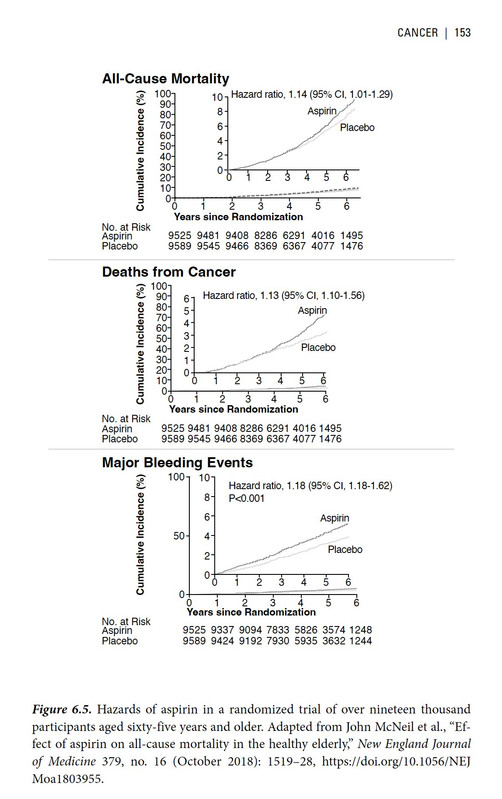
- No reduction in all‑cause mortality; hazard ratio around 0.95, meaning no statistically significant benefit. thelancet.com
- No reduction in dementia or cognitive decline. thelancet.com
- No reduction in cardiovascular events in healthy older adults. nia.nih.gov
- Increased major bleeding, especially gastrointestinal and intracranial. nia.nih.gov
- Higher cancer‑related mortality in the aspirin group in ASPREE (unexpected; still under investigation). nia.nih.gov
 Why people thought aspirin might extend lifespan
 Why people thought aspirin might extend lifespan
Laboratory and animal studies suggested aspirin could:
- Reduce chronic inflammation
- Modulate cellular senescence
- Influence oxidative stress pathways
These mechanisms led to speculation about pro‑longevity effects, but human trials have not confirmed this. thelancet.com
 Age matters — and not in aspirin’s favor
 Age matters — and not in aspirin’s favor
In adults over 60, the risk of bleeding rises faster than the cardiovascular benefit, which is why many guidelines now recommend against starting aspirin for primary prevention in this age group. mayoclinic.org
There is some exploratory evidence that people over 80 might benefit more, but this is not confirmed and remains speculative. thelancet.com
 When aspirin does improve survival
 When aspirin does improve survival
Aspirin does reduce mortality and major cardiovascular events in secondary prevention—that is, people who already had:
- A heart attack
- A stroke
- Coronary artery disease
In these cases, aspirin clearly improves survival, but this is not “longevity enhancement”—it is prevention of recurrent events. mayoclinic.org
 Risks that counteract longevity
 Risks that counteract longevity
- Major bleeding (3.8% on aspirin vs 2.7% on placebo in ASPREE). nia.nih.gov
- Hemorrhagic stroke risk increases. mayoclinic.org
- Gastrointestinal ulcers and bleeding. mayoclinic.org
- Possible increased cancer mortality (ASPREE finding; still debated). nia.nih.gov
These risks directly undermine any theoretical longevity benefit.
 Bottom line
 Bottom line
Aspirin does not extend lifespan or healthy lifespan in people without cardiovascular disease.
For older adults, especially ≥70, aspirin may increase harm, not reduce it.
Its only proven survival benefit is in secondary prevention of cardiovascular disease.